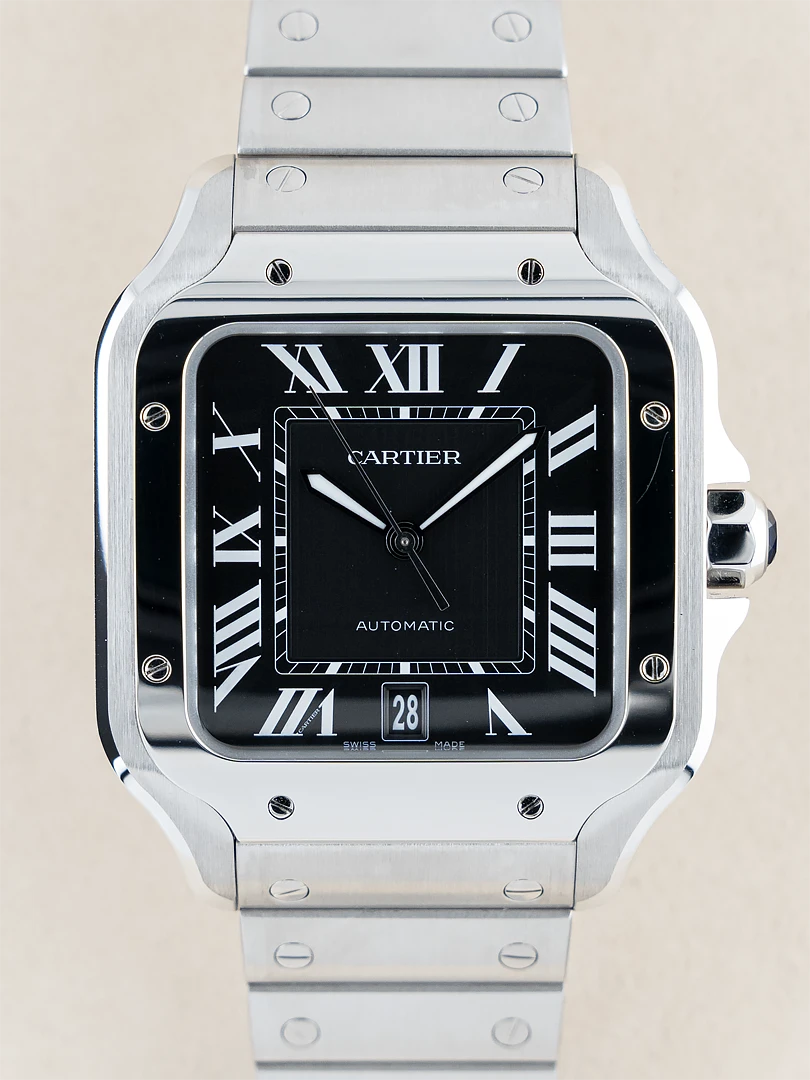
Buy Cartier Watches in Australia – Sydney’s Trusted Grey Market Dealer
Most watch brands earn their reputation through what happens inside the case. Cartier earned theirs through what happens on the outside. The Tank’s rectangular case. The Santos’ square case with exposed screws. The Ballon Bleu’s distinctive crown protector nestled into a smooth, spherical case. These are watches that people recognise from across the room, and that recognition is built from more than a century of deliberate, considered design that has never really gone out of fashion.
Cartier occupies a genuinely unusual position in the watch market. It’s simultaneously one of the world’s most prestigious jewellery houses and a serious watchmaker with legitimate movement credentials. That combination, jewellery-informed aesthetics with real horological depth, produces watches that attract a different buyer to the sports-watch-obsessed secondary market for Rolex and Patek. People who buy Cartier usually know exactly what they want, and they usually know why.
Watch Avenue stocks a curated range of Cartier watches, new and pre-owned, each authenticated before sale and backed by our dealer warranty. Browse our current Cartier collection and keep reading for the complete breakdown on models and how to buy smart.
Cartier Models Available at Watch Avenue
The Tank – More Than a Century of the Same Good Idea
The Tank has been in continuous production since 1917, which makes it one of the oldest continuously produced watch designs in the world. Louis Cartier drew inspiration from the aerial view of a Renault tank on the Western Front, and the rectangular case with raised side lugs that evoke the caterpillar tracks became one of the most recognisable watch silhouettes ever created.
There are several Tank variants in current production, and each has a distinct character.
Tank Must
The current entry point to the Tank family, running in stainless steel with quartz or mechanical movements, depending on the reference. Available in small, medium, and large case sizes, with white, silver, and sunray dials on a leather strap. The Must name has a heritage of its own from the 1970s Cartier Must collection, which made the brand more accessible, and Cartier has leaned into that heritage deliberately with this reissue.
Tank Louis Cartier
The purest expression of the original 1917 design, available in white and yellow gold, running a small mechanical movement with the classic Cartier deployment clasp on a leather strap. This is the version collectors care about most within the Tank family. Clean, thin, and uncompromising in its refusal to add anything that isn’t strictly necessary.
Tank Américaine
A stretched, elongated interpretation of the Tank with a curved case that follows the wrist more closely than the flat rectangular Tank Louis. Available in steel and gold configurations. The longer proportions suit a slightly sportier, more contemporary styling context.
Tank Française
The steel version with an integrated bracelet rather than a leather strap. The bracelet’s square-link construction is visually consistent with the case shape and gives this version a more robust, everyday wearable character than the strap-bound gold models.
Tank Cintrée
A curved, elongated Tank variant with a more dramatically tapered silhouette. Produced in smaller quantities and representing the more architecturally ambitious end of what the Tank design can become.
Movements: Cartier calibre 049 (quartz), calibre 1847 MC (automatic), calibre 430 MC (manual) across variants
Case materials: Stainless steel, yellow gold, white gold, rose gold
Dial options: White, silver, champagne, and various precious stone dials on higher references
The Santos – The World’s First Modern Men’s Wristwatch
The Santos has a genuine historical claim that no other watch can match. In 1904, Brazilian aviator Alberto Santos-Dumont asked his friend Louis Cartier to design a watch he could read while flying, without having to reach for a pocket watch. The result was a square watch worn on the wrist, secured with a bracelet, which was a genuinely revolutionary concept at the time. The Santos is widely considered the first modern men’s wristwatch.
The current Santos de Cartier runs in two sizes: medium (35.1mm) and large (39.8mm), in steel, two-tone steel and gold, and full yellow gold. The integrated bracelet features exposed polished screws along the case flanks and bezel, a design detail that Cartier introduced in 1978 and that has defined the Santos aesthetic since. The interchangeable strap system, using a quick-release mechanism without tools, is a practical modern addition that lets owners move between the metal bracelet and a leather or rubber strap.
Santos de Cartier Large (ref. WSSA0018)
The current men’s primary reference at 39.8mm in steel on an integrated bracelet, running the calibre 1847 MC automatic with a 40-hour power reserve. Silver or black dial.
Santos WSSA0030 Skeleton
The skeletonised Santos reveals the movement architecture through an openworked dial, the Santos’ exposed screw aesthetic extended from the case to the movement itself.
The Santos is both historically significant and genuinely wearable as a daily watch. It sits at a price point that’s more accessible than the equivalent Patek or AP sports watches and offers stronger brand recognition than most of what’s available at that level.
The Ballon Bleu – Cartier’s Contemporary Signature
The Ballon Bleu was introduced in 2007 as Cartier’s new proprietary case design, a departure from the historical references of the Tank and Santos toward something entirely contemporary. The spherical crown protector integrated into the case at four o’clock became the defining design element, giving the watch its distinctive silhouette from any angle.
Available in an extensive range of case sizes from 28mm through to 42mm, in steel, steel and gold, and full precious metal configurations. The Ballon Bleu is available as a time-only watch, with a date, and as a chronograph. It’s also produced across a wide range of dial colours, including the blue sunray gradient that gives the collection its name.
The Ballon Bleu is Cartier’s most commercially successful current model and represents the broadest range of configurations in the current catalogue. For buyers looking at Cartier for the first time who want something that reads unambiguously contemporary, this is the reference that makes the most sense as a starting point.
Case sizes: 28mm through 42mm across multiple variants
Materials: Stainless steel, rose gold, white gold, yellow gold, two-tone
Dial options: Silver, blue, champagne, guilloché patterns, gem-set versions
Movements: Quartz or automatic, depending on size and reference
The Panthère – The Jewellery Watch Worn as a Watch
The Panthère de Cartier sits closer to the jewellery side of what Cartier produces than anything else in the current lineup. The square case, integrated mesh bracelet, and panther head crown are explicitly jewellery-house design language applied to a wristwatch, and the result is unmistakably Cartier in a way that even the Tank and Santos aren’t.
Available in mini, small, medium, and large sizes across yellow gold, white gold, rose gold, and steel. The Panthère is primarily a quartz watch in its standard configurations, with gem-setting options across bezels, dials, and bracelets at various price points. It’s the answer for the buyer who wants something more overtly jewellery-forward than the Santos or Tank.
The Drive de Cartier – The Modern Men’s Dress Watch
The Drive is Cartier’s contemporary men’s dress watch, introduced in 2016 as an alternative to the Santos for buyers who want something more rounded and less architecturally aggressive. The cushion case shape and the guilloché silver dial give it a classical character that works in formal contexts where the Santos might be too assertive.
Available in steel and gold, running the in-house calibre 1904-PS MC automatic. The Drive sits in an underrated part of the Cartier collection and represents good secondary market value for buyers who understand the brand.
The Rotonde and Clé de Cartier – Complication Platforms
The Rotonde de Cartier and Clé de Cartier collections are where Cartier deploys its serious watchmaking ambitions, including tourbillons, flying tourbillons, perpetual calendars, and multi-complication references. The Rotonde’s round case is a more conventional setting for grand complications. The Clé’s distinctive key-shaped crown, integrated into the case at twelve, allows all functions to be set via a single crown rotation, which is an engineering achievement that sounds simple and is anything but.
These are collector and complication-buyer territory, and they appear in the secondary market with varying frequency.
Why Buy Cartier Through a Grey Market Dealer?
The Cartier situation differs from the Holy Trinity brands but has its own secondary market logic worth understanding.
Pre-owned pricing means meaningful savings on a brand that depreciates
from retail
Cartier watches at retail carry pricing that reflects both the movement and the house’s jewellery heritage and design prestige. On the secondary market, particularly for steel and quartz references, prices sit at a genuine discount to retail, and a well-preserved pre-owned Cartier in excellent condition with box and papers represents honest value compared to buying new. For buyers who don’t need the box sealed, this is simply the smarter way to purchase.
Access to discontinued and vintage references that are genuinely
desirable
Cartier has an extensive archive of references that are no longer in production and that appear only in the secondary market. Vintage Tanks, older Santos configurations, earlier Ballon Bleu references with different case proportions, and past limited editions all exist only through grey market and secondary channels. For buyers with a specific reference in mind, we’re often the fastest route to finding it.
Immediate availability across current production
Cartier doesn’t operate the same allocation-restricted model as Rolex or Patek for most references, but specific configurations, particularly precious metal Tanks and popular Ballon Bleu references in certain sizes, can have variable availability through authorised retail. We carry current references available for immediate purchase.
Authentication on a brand where fakes exist at volume
Cartier’s visibility and the relatively modest price points of entry-level references make them a target for counterfeiting at a level that higher-priced Holy Trinity watches are not. The Tank Must and Ballon Bleu, in particular, have convincing counterfeits in the market. Every watch we sell is authenticated before it reaches a client, which is more important for Cartier than for watches where the price point makes faking less commercially attractive.
A Brief History of Cartier
Cartier was founded in Paris in 1847 by Louis-François Cartier, who took over his master’s workshop on the Rue Montorgueil. The brand built its early reputation supplying jewellery to European royalty and aristocracy, and the three sons of Louis-François, Louis, Pierre, and Jacques, expanded the house into London, New York, and international markets in the early twentieth century.
The watchmaking came from Louis Cartier, the grandson of the founder, who had the design instincts and the social connections to turn wristwatch wearing from a women’s accessory into a serious proposition for men. The Santos commission for Alberto Santos-Dumont in 1904 was the defining moment. The Tank in 1917 cemented the house’s visual language in watchmaking for the century that followed.
Cartier has been part of the Richemont group since 1988 and today operates more than 200 stores globally. The movement manufacturer, which had historically relied on external suppliers, has been progressively brought in-house since the late 1990s with the development of the proprietary calibre series. Cartier now produces the majority of its movements in-house, which matters for secondary market servicing and long-term ownership.
Frequently Asked Questions About Buying Cartier Watches
Are grey market Cartier watches genuine?
Yes. Grey market means the watch has been sold outside the authorised Cartier retail network, which is entirely different from counterfeit. These are authentic Cartier watches with genuine movements, cases, and bracelets. At Watch Avenue, every Cartier undergoes authentication before sale, which is particularly important given that Cartier references at lower price points attract more counterfeiting activity than higher-priced watches. Our dealer warranty covers every purchase.
Which Cartier watch is the best value?
The Santos de Cartier in steel is consistently regarded as the strongest value proposition in the Cartier lineup. It’s historically significant, genuinely distinctive, practically wearable as a daily watch, and trades at reasonable secondary market pricing relative to its presence and quality. The Tank Louis Cartier in gold is the answer for buyers who want heritage prestige, and it appears at secondary market prices that often represent genuine value compared to comparable thin gold dress watches from other houses.
Do Cartier watches hold their value?
Cartier watches generally depreciate from retail in the short term, with some exceptions for limited editions and specific precious metal references in excellent condition. The Tank Louis Cartier in gold and certain Panthère configurations have shown stronger long-term value retention. Steel and quartz references tend to depreciate more from retail, which is why the grey market pre-owned route offers better value for buyers who research before purchasing.
What’s the difference between the Santos and the Tank?
The Santos is a square watch with exposed screws and an integrated bracelet, rooted in the first modern men’s wristwatch from 1904. It has a more architectural, almost industrial character. The Tank is a rectangular watch in a softer, more classical tradition, typically on a leather strap, drawing from the 1917 original. Both are definitively Cartier, but they project very different personalities. The Santos tends to be the stronger choice for a daily sports-dress watch. The Tank leans more toward formal and dress occasions.
Can I sell or trade my Cartier through Watch Avenue?
Yes. We buy Cartier watches outright and handle trade-ins. Get in touch with details and photos, and we’ll provide a market-based valuation. If the number works for you, we can settle quickly. We also offer consignment for clients who prefer to hold out for full market pricing.
Does Watch Avenue source specific Cartier references on request?
Yes. If you’re looking for a specific Tank configuration, a particular Ballon Bleu dial colour, or a discontinued reference, get in touch through our sourcing service. We can typically provide availability and pricing within a few days and turn around sourced watches within one to two weeks for most references.
Watch Avenue is a Sydney-based watch expert and advisor specialising in luxury pre-owned and grey-market watches. We work with clients across Australia to buy and sell high-end timepieces. Get in touch with the team to see how we can help you.